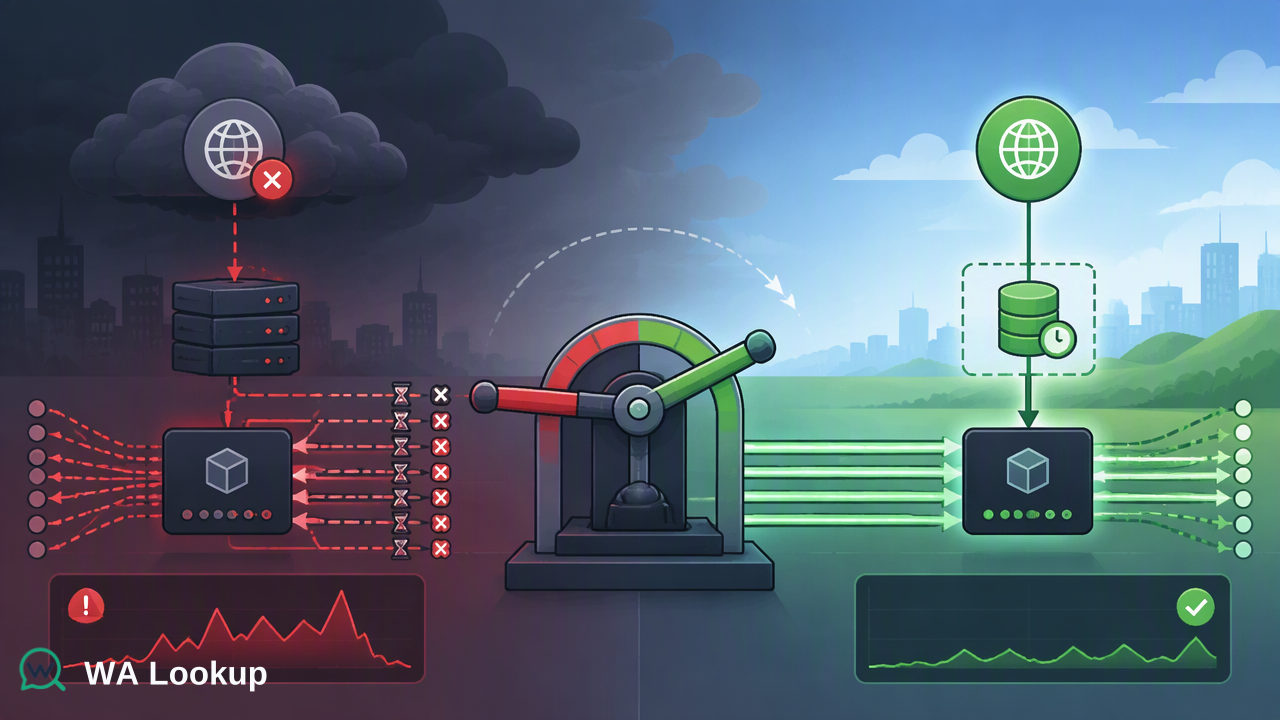
When processing large-scale contact validation—such as verifying 100,000 phone numbers against a registration signal—the primary architectural challenge is not the throughput of the validation service itself, but the fragility of the client-side orchestration.
In a typical batch workflow, a script reads a source file, iterates through the entries, and dispatches requests to an API. If the process terminates at the 40,000th entry due to a network timeout, a memory leak, or a server-side restart, the naive approach is to restart the entire batch. This is inefficient, costly, and redundant. To build resilient systems, we must decouple the processing state from the execution environment.
The Architectural Decision: Local State Manifests
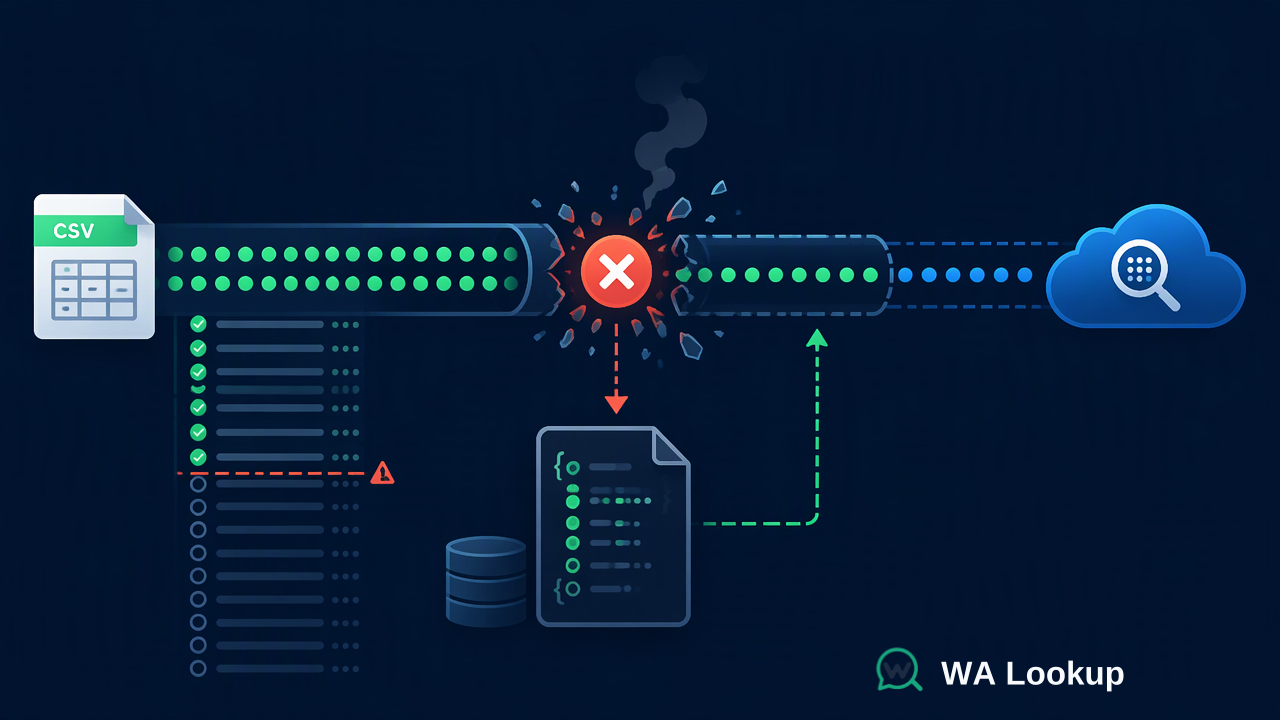
The most effective way to handle long-running batch operations is to implement a local state manifest. Instead of treating the input file as a static stream, the system treats it as a queue that is continuously reconciled against a persistent local record.
The Mechanism
- Initialization: Before processing begins, the system generates a manifest file (typically JSON or a local SQLite database) that maps every input identifier to a status flag (e.g.,
pending,in_progress,completed,failed). - Execution Loop: The script reads the manifest to identify
pendingentries. It processes these in chunks—leveraging the multi-check capabilities of the API—and updates the manifest status immediately upon receiving a successful response. - Resumption: If the process crashes, the next execution reads the manifest, identifies the entries marked as
pending, and resumes exactly where the previous run stopped.
Trade-offs and Constraints
This architecture introduces specific trade-offs that must be managed:
- I/O Overhead: Updating a manifest file after every request or chunk introduces disk I/O latency. For high-velocity systems, writing to a local database like SQLite is often more performant than rewriting a large JSON file.
- Consistency Risks: There is a potential for a race condition if the process crashes exactly between receiving a response and writing the update to the manifest. To mitigate this, the system should implement an "at-least-once" processing model. If an entry is marked
in_progressbut the process terminates, the system should re-verify that specific entry upon restart to ensure the result is captured. - Storage Requirements: For a list of 100,000 numbers, the manifest file is relatively small. However, as the scale grows into the millions, the manifest itself becomes a significant data structure that requires indexing to remain performant.
Rejected Alternative: Stateless Retries
A common alternative is to rely on stateless retry logic with exponential backoff. In this model, if a request fails, the system simply retries the specific request.
While this handles transient network errors, it fails to address process-level termination. If the entire script crashes, the stateless approach provides no mechanism to remember which of the 100,000 numbers were already processed. You would be forced to re-submit the entire batch, leading to redundant API calls and unnecessary consumption of balance. The manifest-based approach is superior because it persists the "knowledge" of the system across process lifetimes.
Operational Risks and Edge Cases
A significant edge case involves handling "undetermined" or "service-error" responses. In many validation workflows, a failed request is not the same as a negative result (e.g., registered=false).
If the API returns a service error, the manifest should mark the entry as failed or retry_pending rather than completed. If you treat a service error as a definitive result, you risk corrupting your dataset with false negatives. Your architecture must distinguish between a successful validation (which is billable and definitive) and a technical failure (which requires a retry).
Furthermore, when using bulk asynchronous tasks—where you submit a file and receive a task ID—the manifest must track the task_id associated with specific ranges of your input file. If the process crashes while waiting for a bulk task to complete, the manifest allows you to poll the status of that specific task_id rather than re-submitting the file and creating duplicate tasks.
Evidence for Invalidation
This architectural decision is based on the assumption that the cost of redundant API calls outweighs the cost of managing local state. This decision would be invalidated if:
- API Pricing Model Changes: If the validation service moved to a subscription model with unlimited calls, the cost of redundancy would drop to zero, making the complexity of a manifest unnecessary.
- Infrastructure Reliability: If the execution environment (e.g., a managed serverless function) guaranteed atomic completion of large batches without the possibility of mid-process termination, the need for local state persistence would vanish.
- Throughput Requirements: If the volume of data reached a scale where the local manifest I/O became the primary bottleneck, a distributed state store (like Redis) would be required, shifting the architecture from a local manifest to a centralized state management system.
Implementation Summary
When architecting for large-scale validation, prioritize the persistence of state. By maintaining a local manifest, you transform a fragile, monolithic script into a robust, resumable pipeline. This approach ensures that your system is resilient to the inevitable instability of network environments and process lifecycles, ultimately protecting your balance and ensuring the integrity of your validation data.
Always consult the current API documentation for your specific service to understand the concurrency limits and timeout behaviors, as these will dictate the optimal chunk size for your processing loop. By aligning your local manifest logic with the service's documented capabilities, you create a system that is both efficient and predictable.
About the author
- https://walookup.com Instantly check if a phone number is active on WhatsApp. Verify one number in seconds.
Comments
Join the discussionNo comments yet. Be the first to comment.